
Celeriac aka Celery Root
poster child for ugly delicious

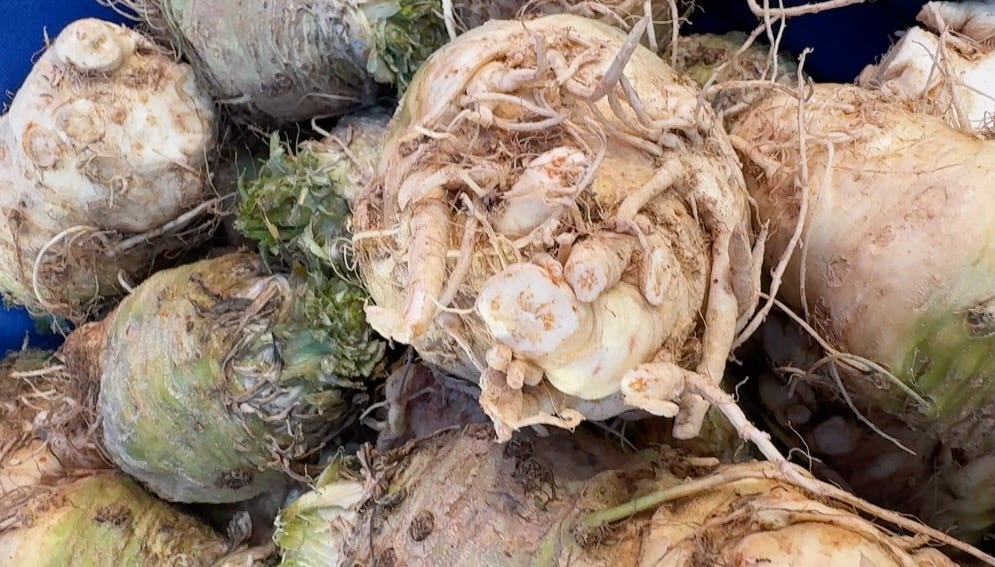
Celery root, aka celeriac, is the knobby, often mud-flecked bulb of a variety of celery grown for its swollen stem base rather than its stalks. It’s ugly and intimidating. Despite its rough and rooty exterior, the interior is creamy white with a dense, crunchy texture when raw. It’s faintly aromatic and tastes like a combination of both celery and parsley, with a bit of nuttiness. Cooked, its texture transforms to silky, with deeply savory flavor. It’s one of those vegetables that feels basic and kind of old-fashioned, and yet it’s appearing more frequently on fine dining menus in a variety of dishes. It’s seasoned like shawarma and roasted whole, it’s cut into thick steaks and roasted accompanied with mole, it’s served pickled as a side, made into slaw, and even transformed into ice cream. Like many root vegetables, it pairs well with nearly any flavor profile. I love it in soups and stews, where it enhances the expected parsley-celery taste profile. It’s also marvelous combined with potatoes as a mash. The mash becomes lighter and more aromatic than standard.
I understand that it’s kind of intimidating because of its appearance. Peeling it is the biggest challenge, which is why most people shy away from the knobby thing. It isn’t difficult to do, but it does require attention since it’s so uneven on the outside. The exterior is thick, fibrous, and irregular. You’re not “paring.” Think of it like you’re carving away armor. I use a sharp paring or chef’s knife instead of a peeler. A vegetable peeler is usually too delicate for the job.
Begin by cutting off the root end and the stem end so the bulb can sit flat and stable on your board. Stability is safety. With a sharp chef’s knife, follow the curve downward, removing thick strips of skin. The gesture is a lot like peeling an orange with a knife, but with more resistance. Work in deliberate downward strokes. You’ll lose more flesh than you expect. That’s normal. The goal is a completely clean, creamy-white surface with no brown threads remaining. Even after the peel is gone, you’ll see little dark pockets and fibrous creases. Carefully dig those out with the tip of your knife. They’re tough and unpleasant in finished dishes. Celery root oxidizes quickly. So if you’re not using it immediately, drop it into acidulated water with lemon juice or vinegar after peeling. Save the trimmings, clean them well, and use them for stocks.
Celery root is so versatile. Raw, you can shave it into salads or atop prosciutto. It’s perfect for slaws of all kinds. The texture and flavor are suited to be tossed with a rich, creamy dressing. There is a reason why céleri rémoulade is the most often seen preparation. Julienned celeriac tossed with mustardy mayonnaise, lemon, and plenty of black pepper. It’s crunchy, sharp, and incredibly refreshing. I have a recipe for you that is a variation with horseradish, mustard, mayonnaise, and heavy cream.
I love crunch, so the first time I made it, I became a bit obsessed and ate it every day for a week. You can roast or sauté it, cut into wedges or cubes with a drizzle of olive oil and salt cooked at high heat until deeply caramelized. Season to your taste. Some suggestions are: brown butter and thyme, pomegranate molasses and parsley, anchovy and lemon zest. It pairs beautifully with roast chicken or pork as a side. Here’s a basic recipe for a pureed soup that you can customize by changing up the herbs and spices or adding another vegetable, like carrots, into the mix. Thick rounds, seared and then roasted, can become a vegetarian centerpiece. Brush with a miso or mustard marinade before roasting. The texture holds surprisingly well. You can also use it in sauces. It’s lower in starch than potato but still creamy, so it’s a great stabilizing base for vegetable sauces or spreads. Celery root is so versatile. Think of it as a savory canvas and check out my visit to the Santa Market Farmer’s Market to hunt down this unsung, seasonal hero.
Celerí Rémoulade aka Creamy Celery Root Salad
1 large celery root
1 tablespoon prepared horseradish or to taste
1 tablespoon Dijon or whole grain mustard
1 cup mayonnaise
1/2 cup heavy cream
Salt to taste
Peel the celery root and cut it in half lengthwise. With the flat side on your cutting board, cut each half into 1/4” thick crosswise half moons. Stack a few up and cut into ¼” julienne strips.
In a bowl, mix together the horseradish, mustard, mayonnaise, heavy cream, and salt to taste. Add the celery root and toss. Correct seasoning if necessary. Can be prepared up to three hours ahead. Serve chilled.
Want to be inspired? Take a look at Dave Beran’s tableside presentation of his celeriac ice cream at Seline.
Where to get it:
Keep your eye out at any restaurant you frequent where the chef shops the farmers markets.
Saffy’s
Roasted celery root with burnt apple harissa, sauerkraut, allium cream, rose petals, curry leaves, cilantro
Destroyer
Pickled celery root with dill, served as an accompaniment
Seline
Tableside service of celery root ice cream
Matu
Purée that accompanies beef cheek and croquettes
Mmmmm, I do love celery root. For a class I taught a couple of weeks ago focused on apples and pears, I included a slaw with celery root, pear, hazelnuts and parsley in a mustardy vinaigrette. It was fun to hear that that was the first taste of celery root for some in the class, and they liked it!