
Zucchini is Here!
the season for the dependable, affordable squash is early


So far this year, the sentences heard most often at the farmers markets are, “I can’t believe (insert here cherries, melons, tomatoes, zucchini) are already here! Last year, it was at least a month later or more!” So yes, zucchini, the vegetable most associated with the abundance of mid-summer, is here. It’s barely June. So assuage your climate change fears with a couple of really great ways to use the dependable vegetable.
I call zucchini dependable because of its mild flavor and texture, which can change depending on what you’re doing with it. It’s also incredibly forgiving due to its high water content. It’s hard to screw up when it comes to cooking zucchini. The only chance at that is if you want to make something crunchy which requires you to grate it first, like for fritters or a scarpeccia, and you don’t squeeze out the water first.
Talking about the water, when making Italian recipes, it’s important to use the green Italian varieties instead of the lighter green, more bulbous Mexican calabacita gris or “gray zucchini.” When harvested, young Italian varieties tend to have firmer flesh, a finer, less watery texture, very small seed cavities, and good structural integrity during cooking. This is why Italian preparations often slice, fry, grill, stuff, or shave zucchini raw. It holds its shape reasonably well. We’ll get to the Mexican variety in a minute.
Once again, I turn to recent Good Food interviews for new ideas for using the inexpensive and dependable zucchini. I recently interviewed Giulia Scarpaleggia about her cookbook, Vegetables the Italian Way, which features several zucchini recipes. Last week, we shared her recipe for Zucchini Carbonara on the Good Food website. In it, she substitutes sautéed zucchini half-circles for the usual pancetta or guanciale. She says, “Crisp crescents of zucchini replace guanciale, mingling with creamy eggs, Parmigiano, and pecorino. The result is a lighter, vegetable-forward homage to the original.” But there is another recipe from her book that I think might become a summer staple in your home.
It’s her White Zucchini Parmigiana about which she says, “Even though I could eat eggplant parmigiana even on the hottest summer day, there are moments when I crave something lighter and fresher. That’s when I turn to this white zucchini and potato parmigiana. Layered with mozzarella, scamorza, Parmigiano, and a generous handful of basil leaves, it’s a dish that captures the essence of an Italian summer.”
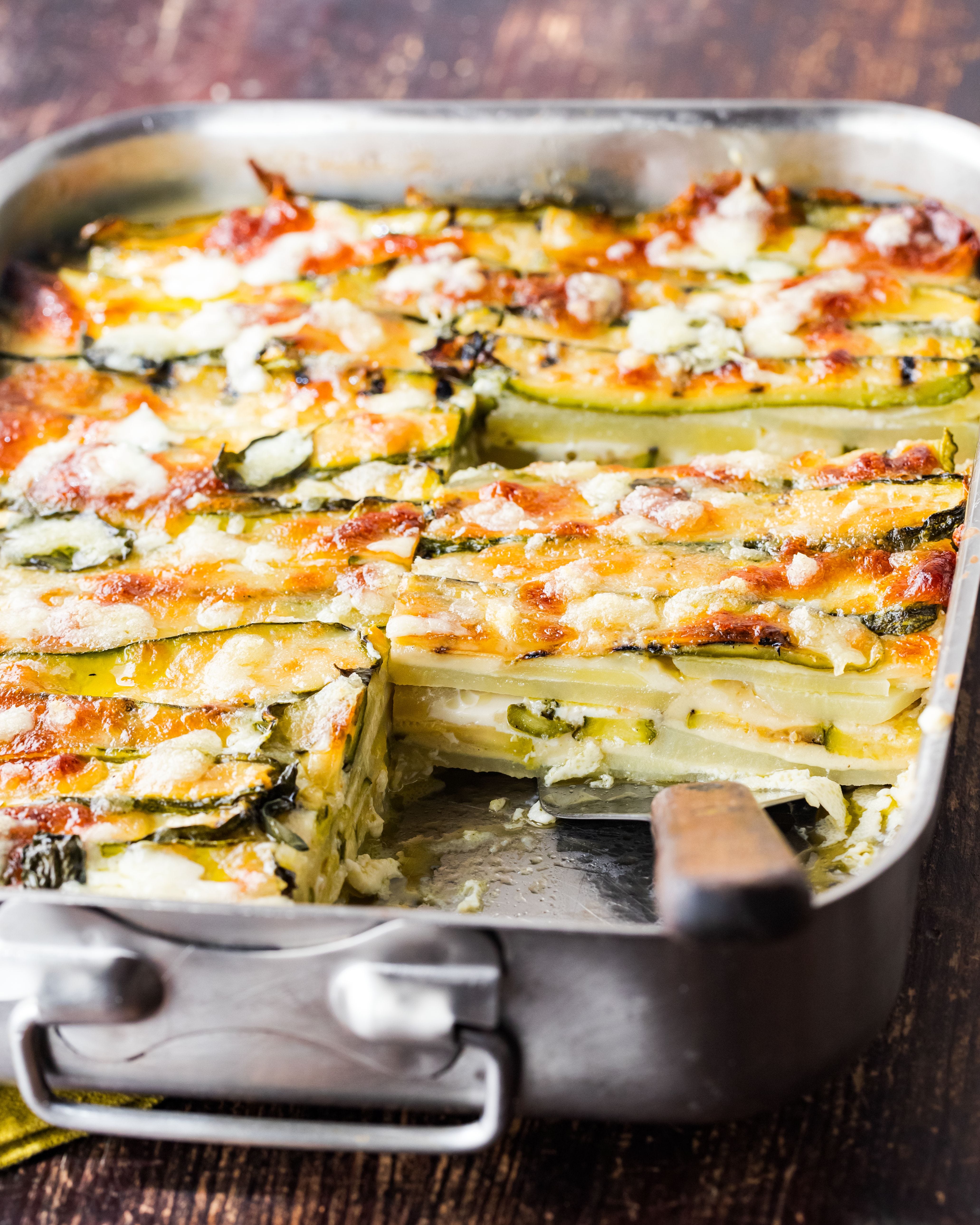
GIULIA SCARPALEGGIA’S WHITE ZUCCHINI PARMIGIANA
Serves 6 to 8
INGREDIENTS
5 medium zucchini (about 21/4 pounds/1 kg total)
Fine sea salt
3 medium potatoes (about 11/2 pounds/700 g total)
Extra-virgin olive oil
1 pound/450 g fresh mozzarella, cut into bite-size pieces
8 ounces/225 g scamorza or provolone, thinly sliced
3 large eggs, lightly beaten
3 1/2 ounces/100 g Parmigiano Reggiano cheese, finely grated (about 1 3/4 cups firmly packed)
Fresh basil leaves
INSTRUCTIONS
Rinse the zucchini and slice them lengthwise into slices ¼ inch/6 mm thick. Set a colander over a bowl and layer the zucchini slices inside, sprinkling each layer with salt. Let them rest for 30 minutes. The salt will draw out excess moisture, making the cooking process easier.
Peel and slice the potatoes into rounds 1/8 inch/3 mm thick. Rinse them and place them in a medium pot. Cover with cold water and add 1 teaspoon salt. Bring the water to a boil, cook for 1 minute, then turn off the heat. Drain the potatoes, rinse them under cold water, and set them aside.
After 30 minutes, gently press the zucchini to remove any remaining moisture and pat them dry with paper towels.
Heat a cast-iron griddle over medium heat until hot (you should feel the heat radiating when you hold your hand above the surface). Working in batches so the zucchini doesn’t overlap, grill the slices until golden brown with charred spots, 2 to 3 minutes per side. Transfer to a plate.
Preheat the oven to 350°F/175°C.
Drizzle a 9-by-13-inch/23 by 33 cm baking dish with olive oil. Start by layering half the potato slices on the bottom. Top with one-quarter of the mozzarella and scamorza, spoon over about one-quarter of the beaten eggs, and sprinkle with one-quarter of the grated Parmigiano. Scatter fresh basil leaves on top.
Next, layer half of the zucchini slices, followed by one-quarter of the mozzarella and scamorza, one-quarter of the beaten eggs, and one quarter of the grated Parmigiano. Scatter more basil leaves.
Repeat both layers again: potatoes or zucchini, cheeses, eggs, Parmigiano, and basil. Finish with a generous sprinkling of Parmigiano, basil leaves, and a drizzle of olive oil. Transfer to the hot oven.
Bake until golden brown on top, 35 to 40 minutes. Serve the parmigiana warm, or let it cool and reheat it later—it’ll be even tastier. Store leftovers in the fridge for 2 days and reheat well before serving.
Excerpted from Vegetables the Italian Way: Turning Simple and Fresh into Extraordinary. © 2026 Giulia Scarpaleggia. Photograph © Tommaso Galli. Reproduced with permission of Artisan Books. All rights reserved.
Despite the name “calabacita gris”, Mexican “zucchini” isn’t really gray. The summer squash is pale green with mottling or a dusty gray-green hue. It’s usually shorter and plumper than Italian green varieties. It often has thinner, more delicate skin, softer flesh, and a slightly larger seed cavity, along with a sweeter, more squash-forward flavor. Personally, I love it. It’s often seen in soups and stews, corn and squash combos, sautéed squash with onions and chiles, and braises where zucchini partially melts into the sauce.
From an historical perspective, Italian zucchini as we know it is a relatively recent European development. The squash species originated in the Americas, traveled to Europe after contact, and Italians developed the elongated “zucchini” style. So in a funny way, Mexican gray squash, aka calabacita, is probably closer to older “New World” squash traditions, while the dark green zucchini is an Italian reinterpretation.
In an upcoming interview with Claudette Zepeda, I talked to her about growing up between San Diego and Tijuana and her book, Cooking the Borderlands. She has a recipe for a Braised Zucchini and Corn Casserole. She says she likes to think of the dish as Ratatouille’s Mexican cousin, packed with spice and smoke from chipotles and drenched in savory tomato and Mexican oregano sauce. You’ll just have to buy the book for that, but I was able to get Claudette’s recipe for a Monterrey-Style Guacamole.
She says the addition of blended zucchini and crema in this recipe adds tang and helps to slow down the avocado’s oxidation.
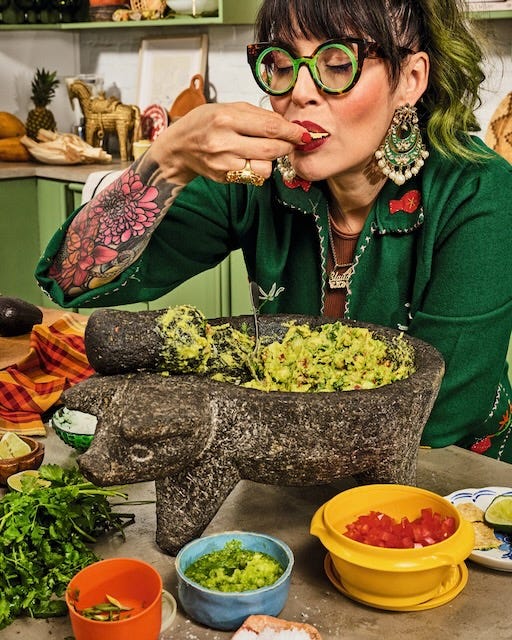
CLAUDETTE ZEPEDA’S MONTERREY-STYLE GUACAMOLE
When you ask anyone about mole, ten out of ten people will start talking about black mole or mole poblano. Few people realize they’re forgetting an even more popular mole: avocado mole. Yep, guacamole is technically a mole made from avocados—the Aztecs ate it with ground chiles and tomatoes and considered it a gift from the gods. Nuevo León, whose capital is Monterrey, is the home of one of the three wild varietals of avocado; you can still find aguacates criollos (Creole avocados) in the valleys and mountains. They have a different texture, and the pit takes up three-quarters of the inside of the fruit, which has a thinner, longer shape. For this recipe, you can use the more common Hass avocado. The addition of blended zucchini and crema in this recipe adds tang, richness, and sweet “green” flavor, making this guacamole taste more like the kind meant to be spooned onto tacos at taquerias. It also helps to slow down the avocado’s oxidation.
Serves 4 to 6 (or one of me when I’m hangry)
INGREDIENTS
1 small zucchini
1 garlic clove
Juice of 3 limes (about 6 tablespoons), plus more to taste
6 whole dried chiles piquines (pequin peppers)
½ teaspoon sea salt, plus more to taste
6 large ripe Hass avocados
1 small white onion, minced
½ cup minced cilantro
2 teaspoons Mexican crema (optional)
Optional Garnishes
Mexican crema
½ cup diced tomato
Cilantro leaves
2 green onions, green parts only, thinly sliced
INSTRUCTIONS
1. Roughly chop the zucchini and purée in a blender or food processor. Set aside.
2. In a large molcajete, combine the garlic clove, lime juice, chiles, and salt. Use the pestle to grind them into a paste. Transfer to a medium mixing bowl. (If you don’t have a molcajete, grate the garlic and grind the pepper, and combine with the lime juice in a mixing bowl.)
3. Peel and pit the avocados (reserve the pits). Dice them, or, for a shortcut, push the avocado halves through the wire grid of a cooling rack into the mixing bowl. Add in the minced onion, cilantro, and blended zucchini and season with more salt to taste. Mash and mix all the ingredients thoroughly to combine. Stir in 2 teaspoons of crema to prevent oxidation, or place the pits back in the guacamole.
4. When ready to serve, transfer the guacamole to a serving bowl, top with the garnishes (if using), and enjoy with totopos (crispy tortilla chips).
Reprinted with permission from Cooking the Borderlands: Spice and Smoke Between Mexico and the States by Claudette Zepeda. Copyright © 2026 by Claudette Zepeda. Photographs copyright © 2026 by David Alvarado. Published by Clarkson Potter, an imprint of the Crown Publishing Group, a division of Penguin Random House LLC, New York.