
Deep Roots
Literally, and when it comes to regional Indian food

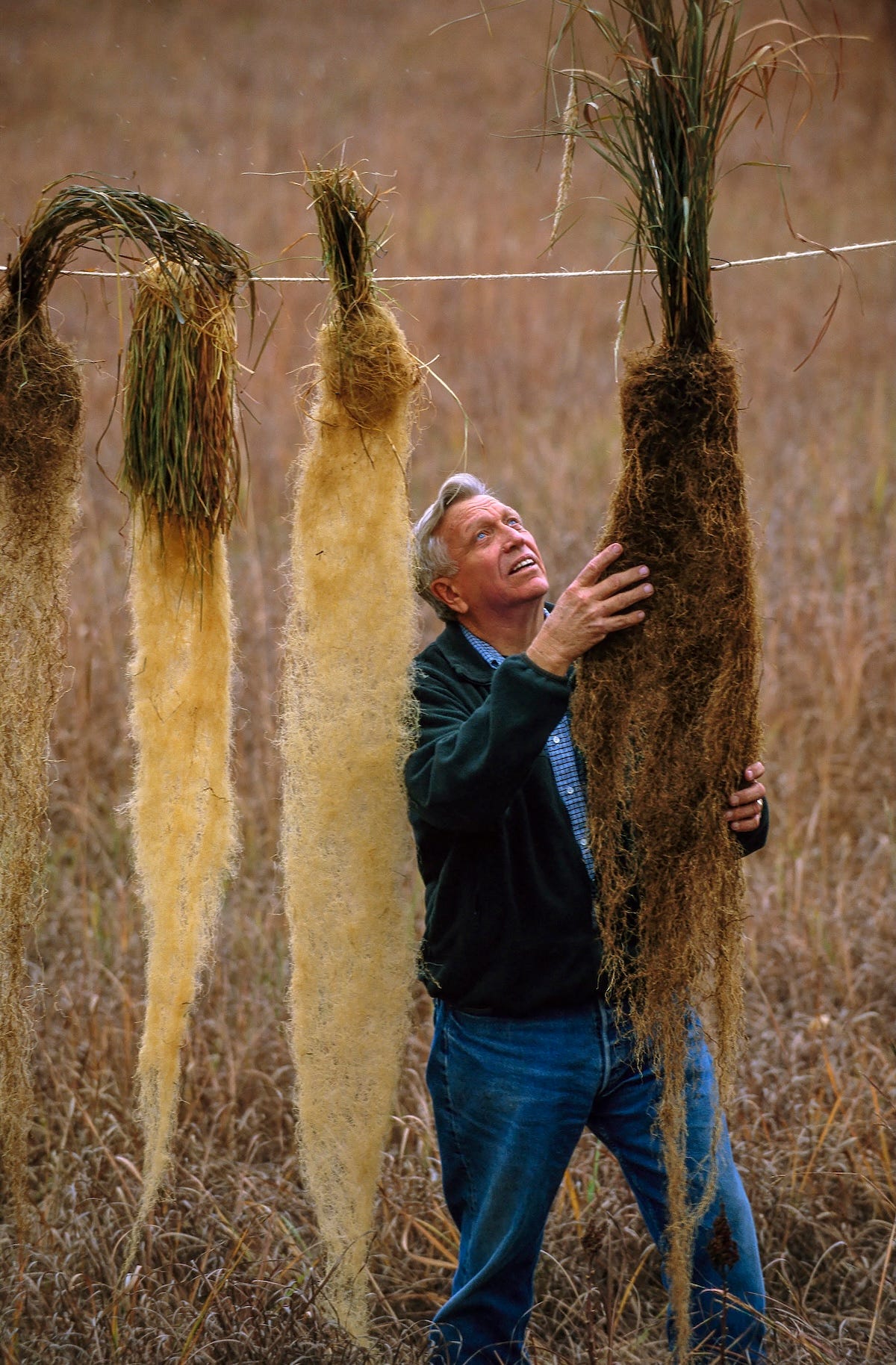
Roots – they can be a strong metaphor or an actual system that not only anchors a plant in place, but also hosts a complex system of nutrition and uptake not only for the plant itself, but for the surrounding soil. Wes Jackson is a visionary plant geneticist and co-founder of The Land Institute. His focus on creating perennial grains jump-started a movement. Imagine what can happen when farmers don’t need to plant seed each year. Imagine what happens below ground when the root system is 4-5 feet long. This week, I talk to co-author/editors Liz Carlisle and Aubrey Streit Krug about their book Living Roots: The Promise of Perennial Foods, a compelling collection of essays that ask us to consider a world in which perennial foods are at the center of our plates.

Another kind of root system is that of people who have a deep relationship to place. They know the land intimately and, from a farming perspective, understand what works best and why, and most importantly, from an eating perspective, how we can cook with those ingredients. I admit to being an early fan of Diaspora Spice Co. I find the work Sana Javeri Kadri does, sourcing spices directly from farmers and forging close relationships with them, to be quite admirable. It leads to deliciousness as is apparent from Sana’s book The Diaspora Spice Co. Cookbook, written with the company’s recipe developer Asha Loupy. This is such an unusual book. At its heart are close to 40 women who welcomed the duo into their homes and were willing to share their recipes.
Favas are plentiful in the markets now, and we often need more ideas for how to use them. When I turned to this page, I immediately wanted to share this recipe for Fava Bean Chutney with you. For those of us unable to dive into the heat of the ghost peppers, I think you would be forgiven for substituting a chile you are more comfortable with.
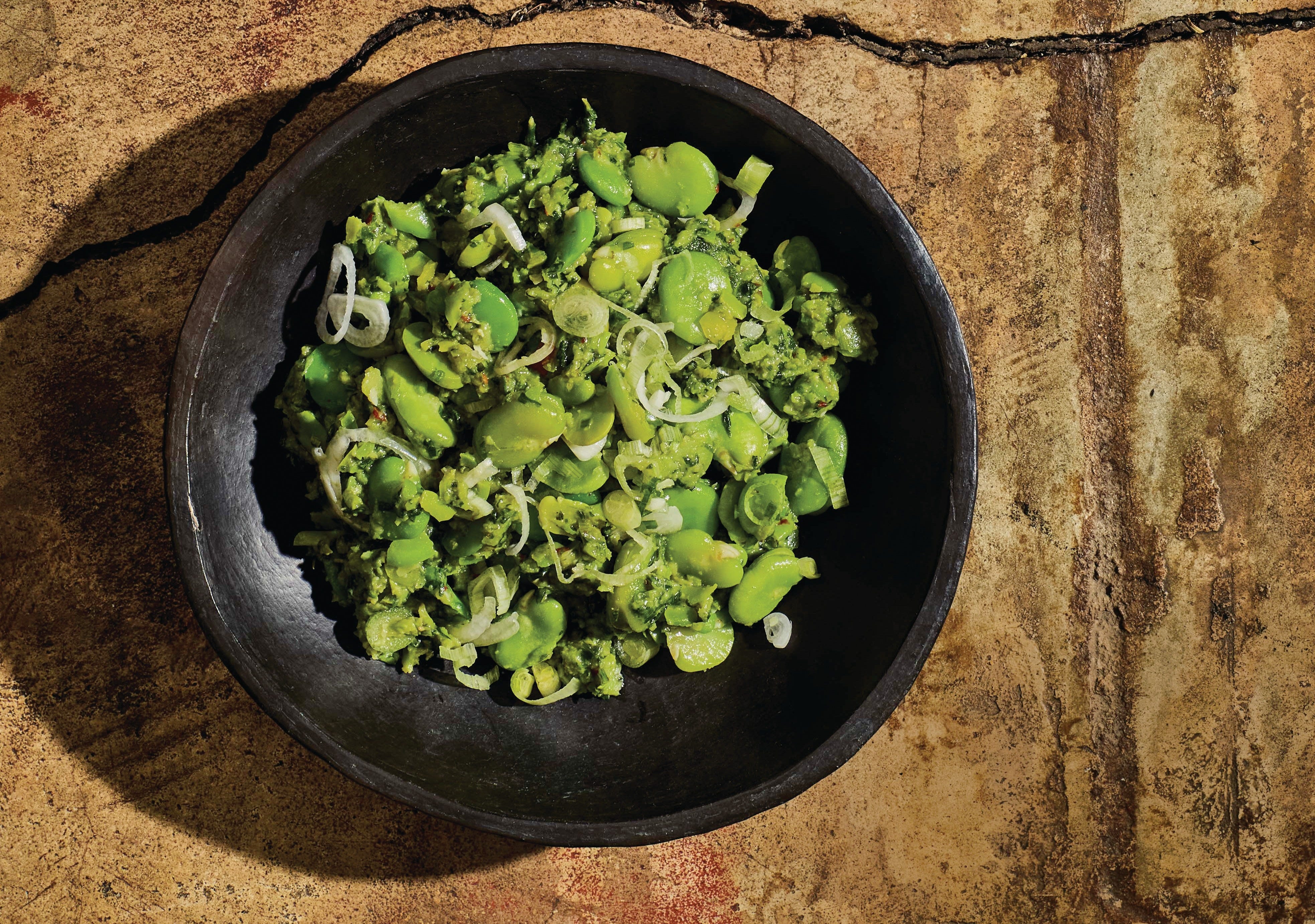
FAVA BEAN CHUTNEY
Chutneys are a way of life in Manipur. The base of these fiery condiments is the Sivathei chilli, which is the Tangkhul name for the naga chilli, bhut jolokia, or, more commonly, ghost pepper. These chillies are famous for their million-plus Scoville units of heat — making them one of the hottest chillies in the world! — and are a cornerstone of Manipuri cooking. We source ours from our friends Zeinorin and Leiyolan in Ukhrul, who slowly smoke them over bamboo mats before drying. To make the chutney, one or two Sivathei chillies are rehydrated, pounded with garlic and salt, then combined with seasonal vegetables and herbs, like fava beans, tomatoes, and potatoes.
Every Manipuri meal has at least one chutney, scooped up in tiny bites with mountains of piping hot rice and a simply braised meat, vegetable, or smoked fish curry. S
Recipe by Zeinorin Angkang. Origin: Ukhrul, Manipur
Makes 1 cup
INGREDIENTS
1/2 to 1 dried Sivathei chilli (or any dried/ smoked ghost pepper)
1 1/2 pounds (680 g) fava beans in the pod
1 garlic clove, roughly chopped
1 teaspoon fine sea salt, plus more if needed 3 spring onions or 4 green onions
1/2 cup (10 g) roughly chopped mint leaves
Juice of 1/2 lemon (1 to 2 tablespoons), plus more if needed
1 teaspoon fish sauce
RECIPE NOTE: Instead of fava beans, you can use 1 cup (170 g) frozen peas or 1 cup (155 g) frozen, shelled edamame.
INSTRUCTIONS
Place the dried Sivathei chilli in a small bowl, cover with boiling water, and soak for at least 30 minutes.
Shell the fava beans, discarding the outer pods. Prepare an ice bath in a medium bowl. Then, bring a large pot of water to a boil over high heat. Add the shelled fava beans and blanch until they float to the surface and turn bright green, 1 1/2 minutes for smaller beans and 3 minutes for bigger, late-season beans.
Drain and transfer the blanched fava beans to the ice bath for 5 minutes, then peel and discard the outer casing, leaving the bright green beans (you should have about 1 cup blanched, peeled fava beans).
Place the soaked chilli, discarding the soaking liquid, in a mortar along with the garlic and salt. Pound into a fine paste.
Thinly slice the white and light green parts of the spring onions and finely chop the dark green parts.
Add the light and dark green parts to the chilli-garlic mixture along with the mint and pound into a coarse paste. Add half of the fava beans and pound into a very coarse paste.
Add the lemon juice, fish sauce, and the remaining white parts of the spring onion and the other half of the fava beans, and gently fold the ingredients together.
Taste and season with more salt and lemon juice, if necessary. Let sit for 10 minutes for the flavors to marry.
Excerpted from The Diaspora Spice Co. Cookbook. © 2026 by Sana Javeri Kadri and Asha Loupy. Photography © 2026 Melati Citrawireja.. Reproduced by permission of Harvest.
Digestibles
Event: An extraordinary opportunity to hear Chef Sean Sherman, Oglala Lakota, born in Pine Ridge, South Dakota, and author of the newly released cookbook, Turtle Island. Monday, April 13th, from 4:30 to 5:30 PM at Maydan Market, chefs Sean Sherman, Odilia Romero, and Poncho Martinez will lead a panel discussion on how ancestral foodways are shaping the future of American cuisine. Moderated by Javier Cabral of LA Taco, the conversation will explore the intersections of culture, identity, and politics through food. There is also a dinner.
Beauty: Perhaps what you need right now is to gaze upon some flowers.
Explore: “10 LA staircase walks with stunning views of iconic Wright, Neutra and Schindler homes”
Think: The Soup Shouldn’t Cost $34.
Animals: A horse and a dog on a beach
Sigh. They didn’t include the stairs right on the lake, the Mattachine stairs on Cove Avenue that I grew up on. Our house was designed by Neutra associates and our address was 2345 Cove Avenue. Oh well.
You should let them know